
Light bulb bases are categorized primarily by how they connect to a fixture—screw-in, twist-and-lock, pin, or bayonet—with the numbers in their codes indicating the physical size (usually the diameter or pin spacing) in millimeters.
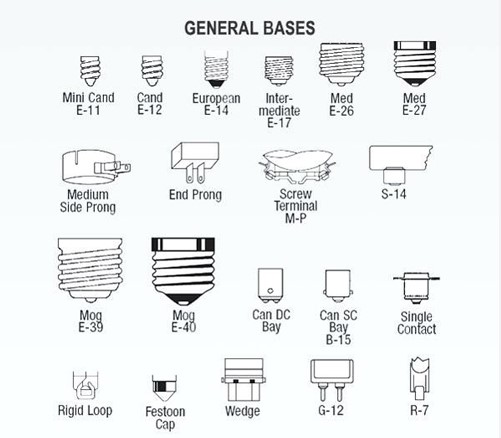
1. Edison Screw Bases (E-Series)
Named after Thomas Edison, these are the most common household bases. The number represents the outer base diameter in millimeters.
-
- E26 (Medium / Standard): Measures 26 mm. It is the standard North American bulb size for daily household use.
-
- Applications: Living room lamps, ceiling fans, porch lights, and standard A19 bulbs.
- Shop E26 Sockets
-
- E27 (European Medium): Measures 27 mm. It is the universal standard across Europe.
-
- Applications: European imported lamps, standard household fixtures abroad.
-
- E12 (Candelabra): Measures 12 mm. Roughly the size of a penny.
-
- Applications: Chandeliers, night lights, holiday window candles, and decorative sconces.
- Shop E12 Sockets
-
- E14 (European Candelabra): Measures 14 mm.
-
- Applications: Imported decorative fixtures, chandeliers, and European home appliances.
-
- E17 (Intermediate): Measures 17 mm. Roughly the size of a dime.
-
- Applications: Microwave interiors, refrigerator lighting, range hoods, and small desk lamps.
-
- E39 / E40 (Mogul): Large industrial screw bases measuring 39 mm or 40 mm.
-
- Applications: Streetlights, commercial warehouses, high-bay factory lighting, and high-wattage HID parking lot lights.
- Shop E39 Sockets
-
- E26 (Medium / Standard): Measures 26 mm. It is the standard North American bulb size for daily household use.
2. Pin Bases (G & GU-Series)
Pin bases use straight or looped metal prongs to transmit electricity. The number indicates the spacing between the centers of the pins in millimeters.
-
- GU10 (Twist-and-Lock): Features two heavy ceramic pins spaced 10 mm apart that you push and twist into place.
-
- Applications: 120V household track lighting, directional art spotlights, and modern recessed kitchen cans.
- Shop GU10 Sockets
-
- GU5.3 / MR16: Low-voltage (typically 12V) needle-sharp pins spaced 5.3 mm apart.
-
- Applications: Landscape path lighting, low-voltage kitchen track lighting, and display cases.
-
- G4 / G9: Miniature capsule pin bases. G4 uses needle pins (4 mm apart), while G9 utilizes looped metal wires (9 mm apart).
-
- Applications: Under-cabinet puck lights, desk vanity accents, and contemporary micro-fixtures.
- Shop G4 Sockets
-
- G13 (Medium Bi-Pin): Standard configuration for long tube lights.
-
- Applications: T8 and T12 linear fluorescent or LED shop lights inside garages and offices.
-
- GU10 (Twist-and-Lock): Features two heavy ceramic pins spaced 10 mm apart that you push and twist into place.
3. Bayonet Bases (B-Series)
Bayonet bases utilize pins on the side of the metal cap that slide into a slot and lock with a brief twist. They are heavily favored in high-vibration applications.
-
- B22 (Bayonet Cap): Standard 22 mm locking base common in the United Kingdom and Australia.
-
- Applications: Standard general-purpose domestic lighting in the UK/Commonwealth.
-
- BA15 (BA15s / BA15d): 15 mm diameter base with either a single (s) or double (d) electrical contact point on the bottom.
-
- Applications: Automotive turn signals, boat cabin lighting, heavy industrial machinery, and RV interiors.
- Shop BA15 Sockets
-
- B22 (Bayonet Cap): Standard 22 mm locking base common in the United Kingdom and Australia.
4. Specialty Bases
- GU24: A dual-pin twist-lock base designed explicitly for self-ballasted energy-efficient bulbs.
-
- Applications: Mandated energy-efficient ceiling fixtures (often found in newer apartments and commercial properties to prevent users from reverting to incandescent bulbs).
- Shop GU24 Sockets
-
- Wedge Bases: Features a flat glass or plastic base where the internal wires exit and fold over the exterior to form a contact.
- Applications: Automotive dashboard displays, landscape tier lighting, and string deck lights.
- Shop Wedge Base Sockets